How we work.

What does this mean?
When we develop a project, it includes housing of all types: low-cost, social housing of various sizes, mid-range, and high-end. The "secret" to maintaining this constant flow of circulating capital is that our construction projects are massive. This results in a significant volume of clients all paying for their homes at the same time, which allows us to negotiate the purchase of construction materials on a large scale and significantly reduce prices. This is precisely why we rely on prestigious local firms to assist us with financial oversight.
Who finances the project?
Evidently, it is the clients who want the houses; therefore, the clients are the ones who must pay for them. There is a widespread bad habit of always questioning who finances a construction project, and it is possible that this is exactly why housing remains a structural problem in every country. No one is going to invest their money to create construction projects in a place where the majority of the population has very limited economic resources. It is time for the people to take charge of their own destiny and, together with the authorities, move decisively toward a solution to the housing problem.
What if the majority of potential clients cannot afford to pay?
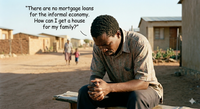
This is, of course, a reality. In Namibia, most potential clients are barred from accessing mortgage loans because their salaries are very low. Because each client thinks about their home individually, the issue becomes much more complicated. This is where one must be able to see that successful projects can only be established by working on large-volume housing construction, backed by the economic power of a significant mass of people contributing funds.
Naturally, not all clients have the same payment capacity.
- Some clients pay in cash.
- Others pay in installments as construction progresses.
- Some clients apply for a mortgage, while others claim their pension in advance to purchase the home.
Evidently, there are also clients whose payment capacity is low or very low, and they represent the most important market niche, despite what one might believe. A large number of people paying a small amount, when united, becomes a large number of people paying a lot.
Regarding this financial section, we also offer the possibility of building studio apartments at the rear of the properties so that the monthly rental income from these units helps pay for the home. In this case, the client signs a contract with us to handle the property management and rent collection. Each month, we deduct that rent from the remaining balance of the home purchase. Furthermore, once the house is fully paid for, ownership of the studios passes entirely to the homeowner.
Which companies do you build with?
- We work with local and international companies and professionals.
- We seek out local artisans to promote and enhance their work.
- We hire technical control professionals to supervise the works.
- We also partner with prestigious firms in the field of financial control and oversight for rigorous project management. Administration is the most critical part of high-volume projects.
Why do you want to implement this project in Namibia?
The answer is simple: Namibian authorities are very clear that the local population needs dignified housing. It doesn’t matter if they are small for the time being; what matters is that families have a roof over their heads, with the possibility of expanding the home later on.
What about the land for construction?
There are many people—thousands, in fact—to whom local authorities have granted a plot of land to build their homes. Unfortunately, if no one facilitates the possibility of building their houses, they will have nothing more than a piece of empty land. The same applies to services like streets, electricity, water, and sanitation; most of the time, local authorities lack the economic capacity to carry out these works. This is why it is so important for authorities, the population, and private operators to work together in search of solutions.
Can people in the informal sector aspire to own a home?
Naturally. The informal sector is welcome; they are our primary clients.